Unpaid leave in Spain: which types exist and what effects they have
Learn about the types of unpaid leave recognised by Spanish law, how long they last, whether the job is kept and what happens to Social Security contributions in each case.

Not every absence recognised by law is paid. Alongside paid leave there is another group of rights that allow employees to stop working for a time, fully or partly, without receiving their salary for that period: parental leave, leaves of absence, reduced working hours and unpaid leave agreed with the company.
Being unpaid does not mean they all work the same way. Each one has its own duration, requirements and effects on the job and on Social Security contributions. In this guide we cover all of them. If you are looking for paid absences, we explain them in our guide to paid leave in Spain.
What unpaid leave is
Unpaid leave is a break from work during which the company stops paying the salary, but the contract remains alive. In most cases, the Workers' Statute treats it as a suspension of the contract: the employee does not work and the company does not pay, but the employment relationship continues and, when it ends, the employee returns to their job or an equivalent one.
Some of these are employee rights that the company cannot refuse if the requirements are met, such as parental leave, leaves of absence for care and reduced working hours. Others depend on an agreement between both parties, such as unpaid leave.
Unpaid leave at a glance
| Type | Duration | Job | Contributions |
|---|---|---|---|
| Parental leave | Up to 8 weeks, until the child turns 8 | Kept | Registration and contributions continue |
| Leave of absence to care for children | Up to 3 years for each child | Same job for the first year; then one in the same professional group | Counts as contributed for benefits |
| Leave of absence to care for relatives | Up to 2 years, unless the collective agreement sets more | Same job for the first year; then one in the same professional group | Counts as contributed for benefits |
| Voluntary leave of absence | From 4 months to 5 years | Only a preferential right to a vacancy | No contributions |
| Agreed unpaid leave | Whatever the parties agree | Kept | The company keeps paying contributions |
| Reduced working hours for care | Between one eighth and half of the working day | Kept | Counts at 100% for benefits for the first three years |
Eight weeks of parental leave
Parental leave, regulated in Article 48 bis of the Workers' Statute, allows each parent up to 8 weeks off to care for a child, or a child fostered for more than a year, until the child turns 8. It is an individual right that cannot be transferred to the other parent.
How it works
- It can be taken continuously or in separate periods, full-time or, once implementing regulations are in place, part-time.
- The employee sets the dates and must give ten days' notice, or the notice set by the collective agreement, save for force majeure.
- The company can postpone it for a reasonable period if two or more employees request it for the same reason or if it seriously disrupts the business, provided it gives written reasons and offers an equally flexible alternative.
- There is no salary or benefit, unless the collective agreement improves on this. While it is taken full-time, the employee stays registered with Social Security and contributions continue.
It should not be confused with the two weeks of birth leave that, since 2026, can be saved until the child turns 8. Those weeks are part of birth leave and are paid by Social Security.

Leaves of absence to care for children and relatives
Article 46.3 of the Workers' Statute recognises two leaves of absence to care for others. The first lasts up to 3 years for each child, counted from the birth or from the adoption, guardianship or foster care decision. The second lasts up to 2 years, unless the collective agreement sets more, to care for a spouse, civil partner or relative up to the second degree who cannot look after themselves and has no paid activity.
What you need to know
- They can be taken in separate periods and are an individual right of each employee.
- If two employees of the same company request it for the same reason, the company may limit them taking it at the same time for operational reasons given in writing, but it must offer an alternative plan.
- Time on leave counts towards seniority, and the employee is entitled to take part in training courses organised by the company, especially on returning.
- The same job is held open for the first year. After that, the guarantee refers to a job in the same professional group. For large families, the job is held open for up to 15 months in the general category and 18 in the special category, and also for 18 months if both parents take it for the same length of time and under the same arrangement.
- No contributions are paid during the leave, but Social Security treats these periods as contributed for retirement, permanent incapacity, death and survivors', and birth and childcare benefits.
Voluntary leave of absence
A voluntary leave of absence, under Article 46.2 of the Workers' Statute, requires no particular reason. Any employee with at least one year of service can request it, for a period of between 4 months and 5 years, and cannot request it again until four years have passed since the previous one ended.
Its main difference from the leaves of absence for care is the return: the employee does not have their job held open, only a preferential right to be re-employed in vacancies of the same or a similar category that exist or arise in the company. If there is no vacancy, they cannot return until there is one. No contributions are paid during a voluntary leave of absence either.
Agreed unpaid leave
Unpaid leave is not regulated as such in the Workers' Statute. It is an agreement between the company and the employee to suspend the contract for a time, which falls under suspension by mutual agreement of the parties. That is why neither side can impose it: the company does not have to grant it, unless the collective agreement provides for it, and it cannot force anyone to take it either.
What is most often overlooked is Social Security. During unpaid leave that is not a leave of absence, the employee remains registered and the company must keep paying contributions, on the minimum base for the contribution group that applies. It is advisable to put the agreement in writing, with its start and end dates.
Reduced working hours for care
Reduced working hours are not a full absence, but they are a way of not working part of the time without being paid for it. Article 37.6 of the Workers' Statute allows the working day to be reduced by between one eighth and half, with a proportional reduction in salary, for anyone directly caring for a child under 12 or a person with a disability who has no paid activity, or who must care for a spouse, civil partner or relative up to the second degree who cannot look after themselves or needs palliative care.
The employee decides the specific schedule within their ordinary working hours and must give fifteen days' notice, or the notice set by the collective agreement. Contributions during the first three years of reduced hours count at 100% for Social Security benefits, as if the hours had not been reduced.
Absences for urgent family reasons beyond the fourth day
Article 37.9 of the Workers' Statute allows employees to be absent from work for urgent family reasons, such as an illness or accident that makes their immediate presence essential. The law only requires the company to pay for hours equivalent to four days a year. Absences for this reason beyond that limit are still justified, but the company does not have to pay for them, unless the collective agreement improves on this.
What the company must do
Managing unpaid leave in an orderly way
- Keep a written record of each request, the date it was received and the company's response.
- Check the notice periods: ten days for parental leave and fifteen for reduced working hours, unless the collective agreement sets others.
- Handle Social Security registration and contributions correctly in each case, because unpaid leave and a leave of absence are not the same.
- Record the start and end dates and plan the return, especially when the job is held open.
- Record these absences in the working time register, so the days not worked do not appear as unjustified absences.
- Apply the same criteria to the whole workforce for leave that depends on an agreement, such as unpaid leave.
How to manage unpaid leave with Horalia
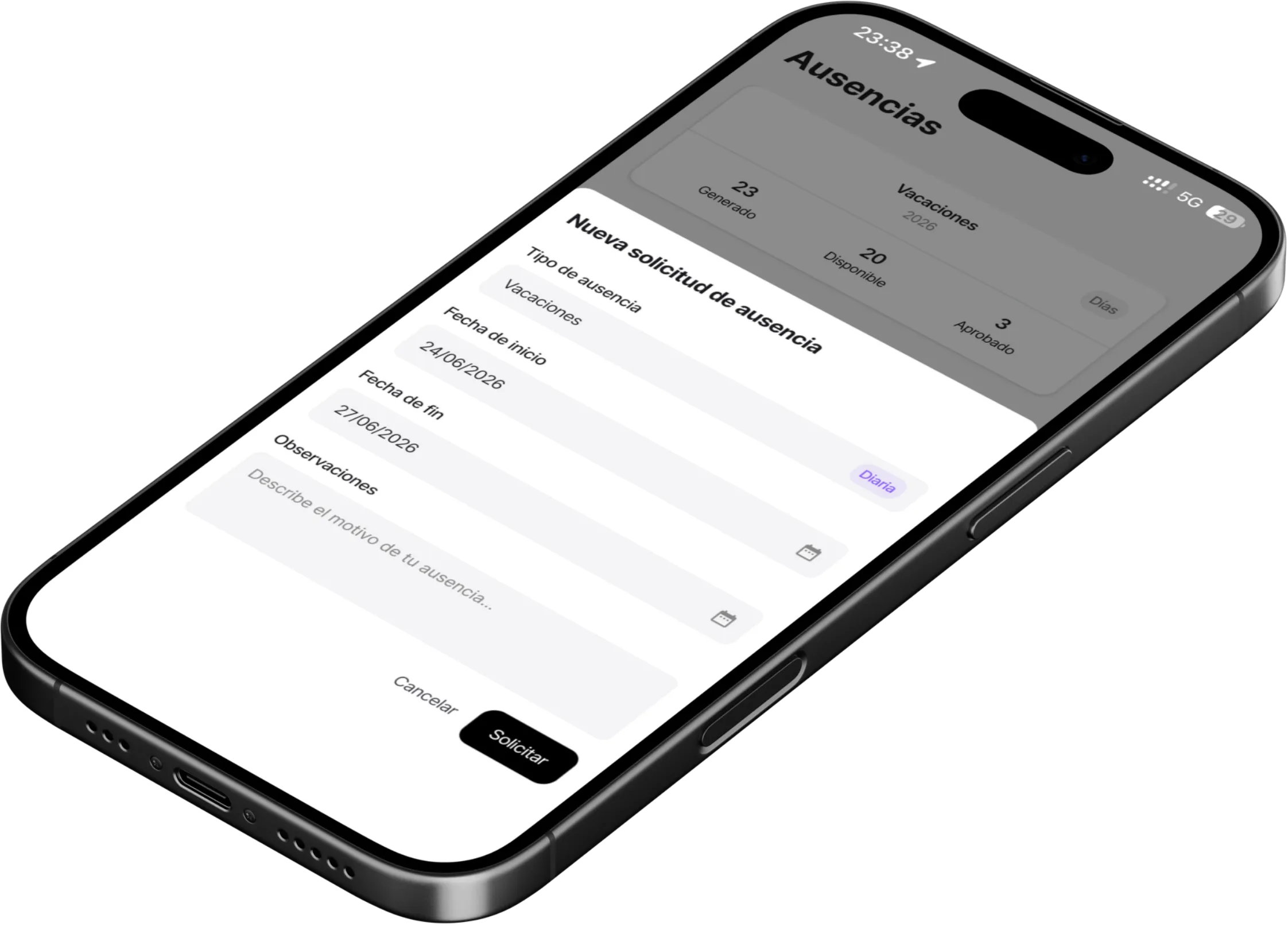
With so many different cases, each with its own deadlines and effects, the hard part is keeping track of who is absent, since when and for what reason. Horalia's absence management brings all of that together in one place.
What it lets you do
- Create an absence type for each kind of leave, paid or not, and assign it to the whole company or to a group of people.
- Request and approve absences from a phone or a browser, with approvers defined for each person.
- Attach supporting documents to each absence, as a photo or a file.
- View the team calendar with every approved absence, updated in real time.
- Link absences to time tracking, so the working time register adds up.
- Export absences for payroll or for an inspection.
If you are interested in the absences that are paid, see our guide to paid leave in Spain and our guide to annual leave in Spain.