Annual leave in Spain: how many days apply and what happens to unused days
Find out how many days of annual leave Spanish law grants, how they are calculated, who sets the dates and what happens to leave that is not taken before the end of the year.

Annual leave is the best-known employment right and yet one of the most confusing when it comes to applying it: how many days does someone who joined mid-year get, who decides the dates, can it be paid instead of taken, and what happens to the days still pending on 31 December?
This guide answers all of these questions based on Article 38 of the Spanish Workers' Statute and the case law that interprets it. We will keep it up to date as the rules or the courts' criteria change.
How many days of annual leave apply
The Workers' Statute sets a minimum of 30 calendar days of paid annual leave for each year of work. Because they are calendar days, weekends and public holidays are included in the count. Some collective agreements express annual leave in working days, which is valid as long as the result does not fall below the legal minimum.
When an employee has not worked the whole year, because they joined or left the company part-way through, they are entitled to a proportional share: 2.5 days for each month worked or, more precisely, 30 days multiplied by the days worked and divided by 365. Someone who starts on 1 July, for example, accrues around 15 days of leave by 31 December. The Workers' Statute does not say how to round decimals: if the collective agreement does not regulate it, it is advisable to set a criterion and apply it equally to the whole workforce.
Days of annual leave in each situation
| Situation | Annual leave entitlement |
|---|---|
| Full year, full-time | At least 30 calendar days |
| Part-time work | The same 30 calendar days. What changes is the pay, not the number of days |
| Contract that starts or ends during the year | The proportional share: 2.5 days per month worked |
| Months on sick leave | Accrue annual leave just like time worked |
| Collective agreement or contract that improves the minimum | The days set by the agreement or the contract |
Who decides when leave is taken
Neither the company nor the employee can set the dates on their own. The Workers' Statute provides that the dates are agreed between both parties, in line with whatever the collective agreement says about annual leave planning.
The rules of the leave calendar
- Each company sets its own leave calendar, within the limits of the collective agreement.
- The employee must know their dates at least two months before the leave begins.
- Leave can be split into several periods. The Workers' Statute refers to a «period or periods» and leaves it to the collective agreement and the parties to decide how to divide them.
- If there is no agreement, the labour court decides through a fast-track procedure, and its decision cannot be appealed.





Is annual leave lost if it is not taken by 31 December?
The general rule is that annual leave is taken within the calendar year in which it accrues. But that rule has an important limit, set by the Court of Justice of the European Union in November 2018 and binding on Spanish courts: employees do not automatically lose pending days because they did not request them.
They only lose them if the company can prove that it encouraged them to take the leave, informed them in good time that it would be lost at the end of the year and that, even so, the employee chose not to take it. If the company cannot prove this, the days still belong to the employee.
Annual leave and sick leave
Annual leave is for rest and sick leave is for recovery, so one cannot absorb the other. When they overlap, the employee keeps the right to take their annual leave at another time, with some differences depending on the type of sick leave.
What happens when annual leave overlaps with sick leave
| Situation | What happens to annual leave | Basis |
|---|---|---|
| Sick leave due to pregnancy, childbirth or breastfeeding, or birth leave | It is taken afterwards, even if the year to which it belonged has ended | Art. 38.3 ET |
| Other sick leave that prevents taking it during the year | It is taken once the sick leave ends, provided no more than 18 months have passed since the end of the year in which it accrued | Art. 38.3 ET |
| Sick leave that starts while the employee is already on holiday | The days that overlap with the sick leave are recovered later | Court of Justice of the EU (2012) |
Sick leave should be distinguished from paid leave, which follows other rules. We explain them in our guide to paid leave in Spain, and the sick leave procedure in our article on sick leave and the medical certificate.
How annual leave is paid
During annual leave, employees must receive their normal pay, as if they were working. Following the Court of Justice of the EU, the Spanish Supreme Court has ruled that this pay includes every item that is received on a regular basis, such as commissions or allowances that form part of the ordinary salary. Only extraordinary items can be excluded.
What a company cannot do is pay for annual leave instead of letting it be taken. The Workers' Statute prohibits replacing it with financial compensation, and the only exception is the end of the contract: if days are still pending when the employment relationship ends, they are paid out in the final settlement.
What the company must do
Annual leave management without surprises
- Plan the calendar in advance, in line with the collective agreement and with enough time to communicate the dates at least two months ahead.
- Keep a record of what has been agreed. It is advisable to record the agreed dates to avoid later disputes.
- Track each employee's balance: days accrued, taken and pending, including the proportional share for new joiners and leavers.
- Give notice before the end of the year to anyone with pending days, in writing and in time for them to take the leave.
- Record annual leave in the working time register as a justified absence, so those days do not appear as unexcused absences.
- Apply the same criteria to the whole workforce, both when allocating the most requested periods and when rounding days.
How to manage annual leave with Horalia
The challenge of annual leave is not knowing the rules but keeping each employee's balance up to date and spreading the periods out without leaving the team short-staffed. Horalia's holiday and absence management brings the whole process together in one place.
What it lets you do
- Request and approve holidays from a phone or a browser, with approvers defined for each person.
- See available days at all times, because each absence is deducted automatically.
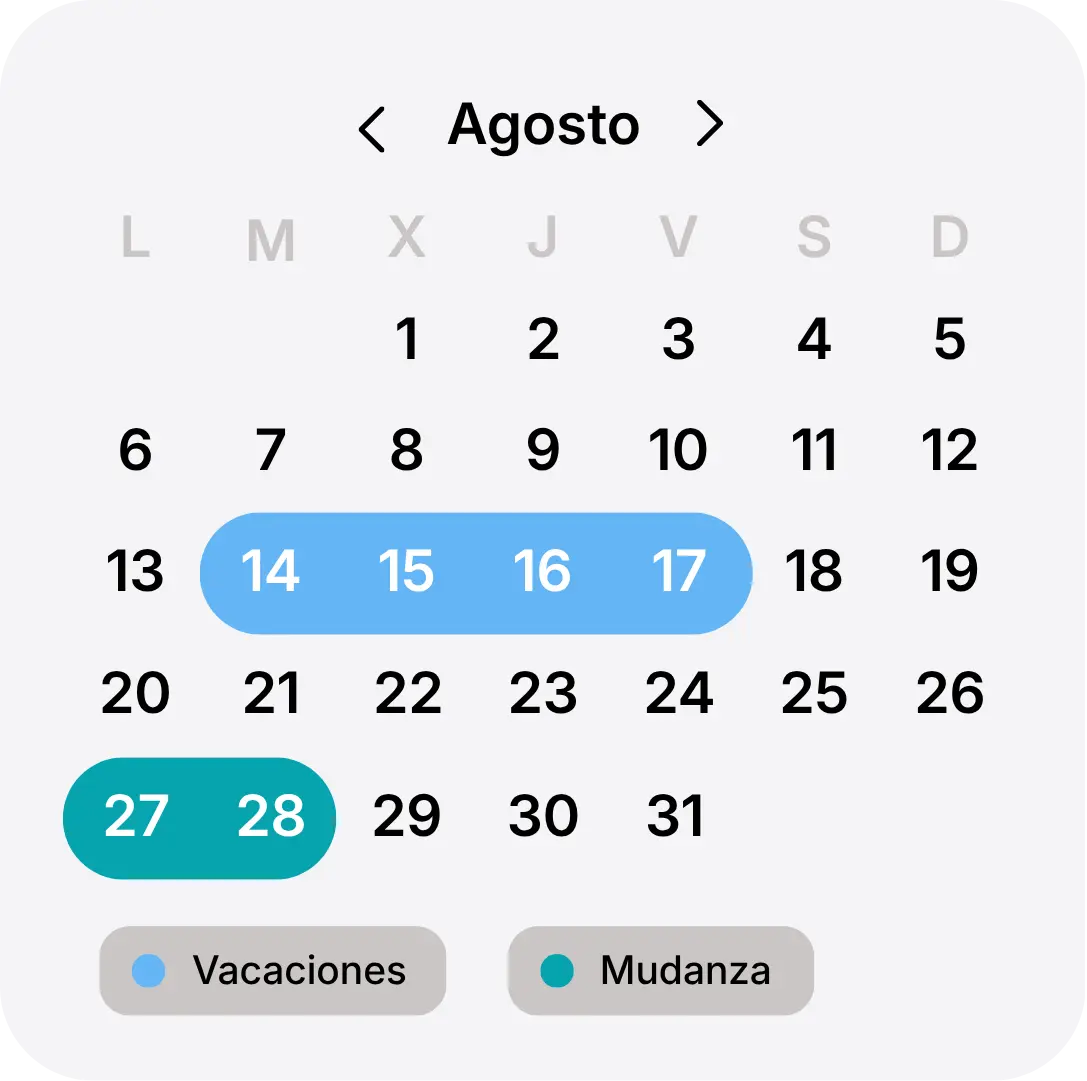
- Apply your own holiday policies with customisable absence types, each with its own colour.
- View the team calendar in real time to anticipate the periods with the most absences.
- Link annual leave to time tracking, so the working time register adds up without redoing any figures.
- Export absences for payroll or for an inspection.