Paid leave in Spain: what types exist and how many days each one grants
Learn about every type of paid leave in Spain's Workers' Statute, how many days each one grants and how employers should manage it.

Paid leave is time off that the employer must grant without deducting it from the employee's salary. It does not come out of annual holidays, the hours do not have to be made up afterwards, and it does not depend on what suits the business: if the situation set out in the law arises and the employee gives notice and provides proof, the leave must be granted.
This guide brings together every type of paid leave currently in force, the days that apply to each one and what the company must do to manage them correctly. We will keep it up to date, because the rules change often: since 2023 several types of leave have been extended, new ones have been created and the Supreme Court has clarified how the days must be counted.
All types of paid leave and their duration
The table sets out the legal minimums that apply to every company. Further down we explain how the days are counted and the details of the cases that raise the most questions.
Paid leave currently in force
| Reason | Duration | Legal basis |
|---|---|---|
| Marriage or registration as a civil partnership | 15 calendar days | Art. 37.3.a) ET |
| Serious accident or illness, hospitalisation, or surgery without hospitalisation that requires rest at home, of a relative or a person living in the same household | 5 working days | Art. 37.3.b) ET |
| Death of a spouse, civil partner or relative up to the second degree | 2 days, or 4 if travel is required | Art. 37.3.b bis) ET |
| Moving to a new permanent address | 1 day | Art. 37.3.c) ET |
| Fulfilling an unavoidable public and personal duty, including voting | The time strictly necessary | Art. 37.3.d) ET |
| Trade union or staff representation duties | As set out in the law or the collective agreement | Art. 37.3.e) ET |
| Prenatal check-ups, childbirth preparation classes and the procedures required before adoption, guardianship or foster care | The time strictly necessary, if they fall within working hours | Art. 37.3.f) ET |
| Inability to reach the workplace because of an emergency or restrictions imposed by the authorities | Up to 4 days, extended for as long as the situation lasts | Art. 37.3.g) ET |
| Preparatory procedures for donating organs or tissue | The time strictly necessary, if they fall within working hours | Art. 37.3 ET, added by Law 6/2024 |
| Force majeure for urgent family reasons | Hours equivalent to 4 days a year | Art. 37.9 ET |
| Breastfeeding a child under 9 months | 1 hour a day, which can be split into two periods or accumulated into full days | Art. 37.4 ET |
| Premature birth or hospitalisation of the newborn after delivery | 1 hour a day while the hospitalisation lasts | Art. 37.5 ET |
| Training related to the company's activity, after at least one year of service | 20 hours a year, which can be accumulated over up to 5 years | Art. 23.3 ET |
Degrees of kinship for hospitalisation and bereavement leave
Hospitalisation leave and bereavement leave apply when the person affected is a close relative of the employee: their spouse or civil partner, or a relative up to the second degree. The degree measures how distant the relationship is, and it can be by blood (the employee's own family) or by marriage (the spouse's family). Uncles, aunts, nephews and nieces are third-degree relatives and, unless the collective agreement extends the scope, do not give rise to this leave.
Relatives up to the second degree
| Degree | By blood | By marriage |
|---|---|---|
| First degree | Parents and children | Parents-in-law, sons-in-law and daughters-in-law |
| Second degree | Grandparents, grandchildren and siblings | Brothers- and sisters-in-law, and the spouse's grandparents and grandchildren |
Hospitalisation leave goes further than bereavement leave. It also covers the civil partner's blood relatives and anyone who lives in the same household and needs to be looked after by the employee, even if they are not related.
How the days are counted
The general rule, established by the Supreme Court, is that leave starts on the employee's first working day. If the event that triggers it occurs on a rest day, the count does not start that day but on the next working day. So if someone who does not work at weekends gets married on a Saturday, their fifteen calendar days start on the Monday.
Leave for hospitalisation or serious illness has generated more litigation than any other since Royal Decree-Law 5/2023 reformed it. The Supreme Court settled the main questions in rulings handed down in November 2025 and early 2026:
The rules for hospitalisation leave
- The five days are working days. The Supreme Court struck down a collective agreement clause that treated them as calendar days: an agreement cannot count them less favourably than the law.
- The employee decides when to start taking them, as long as the hospitalisation or the rest at home continues. They do not have to begin on the day of admission.
- Discharge from hospital does not end the leave if the relative still needs rest at home.
- There is no annual limit. Each separate event gives rise to five new days, even if several occur in the same year.
- There are no longer extra days for travel. The 2023 reform set five days for every case, regardless of distance.


Climate leave
This is the most recent type of leave. It was added to the Workers' Statute as Article 37.3.g) in November 2024, after the floods in Valencia, and many companies have not yet included it in their internal procedures. It entitles the employee to up to four days of paid leave when they cannot reach the workplace or use the roads needed to get there.
How it works
- It applies when the authorities recommend, restrict or prohibit travel, or when there is a serious and imminent risk, such as a disaster or an adverse weather event.
- If the job can be done remotely and communications allow it, the company can arrange remote work instead of granting the leave, provided it complies with the remote work legislation and supplies the necessary equipment.
- If the situation lasts longer than four days, the leave continues until the circumstances that justify it disappear. At that point the company can apply a temporary suspension of contracts or a reduction in working hours on grounds of force majeure.
Absences often confused with paid leave
Many questions arise from absences that are called “leave” or resemble it but work differently. The difference matters: in some cases the salary is paid by the company, in others by Social Security, and in others by no one.
Who pays for each absence
| Absence | Does the company pay? | How it works |
|---|---|---|
| Birth and childcare | No | Suspension of the contract for 19 weeks per parent, or 32 for single-parent families. Social Security pays a benefit of 100% of the contribution base. |
| Parental leave | No, unless the collective agreement improves it | Up to 8 weeks to care for children under 8 (art. 48 bis ET). There is no salary or benefit. |
| Sick leave for a non-occupational illness | Partly | The company pays the benefit from day 4 to day 15. From day 16 Social Security pays it, although the company advances it through the payroll. |
| Personal days | Only if the collective agreement provides for them | The Workers' Statute does not regulate them. They exist only if the collective agreement or the contract grants them. |
| Exams to obtain an academic or professional qualification | Under debate | The Workers' Statute grants leave to sit them (art. 23.1.a ET) but does not say whether it is paid. The National High Court ruled in June 2026 that it is; the Supreme Court has not yet ruled on the matter. |
| Leave of absence to care for relatives | No | Suspension of the contract with the job held open during the first year (art. 46.3 ET). |
What the company must do
Granting the leave is only part of the obligation. The other part is being able to prove, even years later, when it was granted, for what reason and with what supporting document.
The steps of a sound process
- Ask for advance notice. Unless it is impossible, the employee must give notice in advance. If the collective agreement does not set a deadline, reasonable notice is enough.
- Ask for proportionate proof. The company may require evidence of the event that gives rise to the leave, such as a hospital admission record or a death certificate, but not the diagnosis or any other medical data.
- Record the leave in the working time register. Hours of leave are not hours worked, but they must appear as a justified, paid absence so that they are not recorded as an unexcused absence.
- Keep the supporting documents linked to each period of leave, so that they can be found in the event of a claim or an inspection.
- Apply the same criteria to the whole workforce. Granting some people what is refused to others in the same situation exposes the company to claims of unequal treatment.
Changes pending approval
We will update this section as the changes are published. There are currently two agreed measures that are not yet in force. Until they are published in the Official State Gazette (BOE), the days in the table above apply.
Agreed but not yet published
- Extension of bereavement leave to 10 working days for the closest relatives, which could be taken continuously or in separate periods within the following four weeks. The Ministry of Labour and the trade unions agreed on it in December 2025.
- New palliative care leave of up to 15 paid days to accompany a close relative, which could be split into two periods.
How to manage leave without spreadsheets
With thirteen different cases, each with its own duration, relatives and supporting documents, the difficulty is not knowing the rules but applying them consistently every time. Horalia's absence management lets you configure them once and apply them in the same way to the whole workforce.
What it lets you do
- Create an absence type for each kind of leave, with the days it carries, and assign it to the whole company or to a group of people.
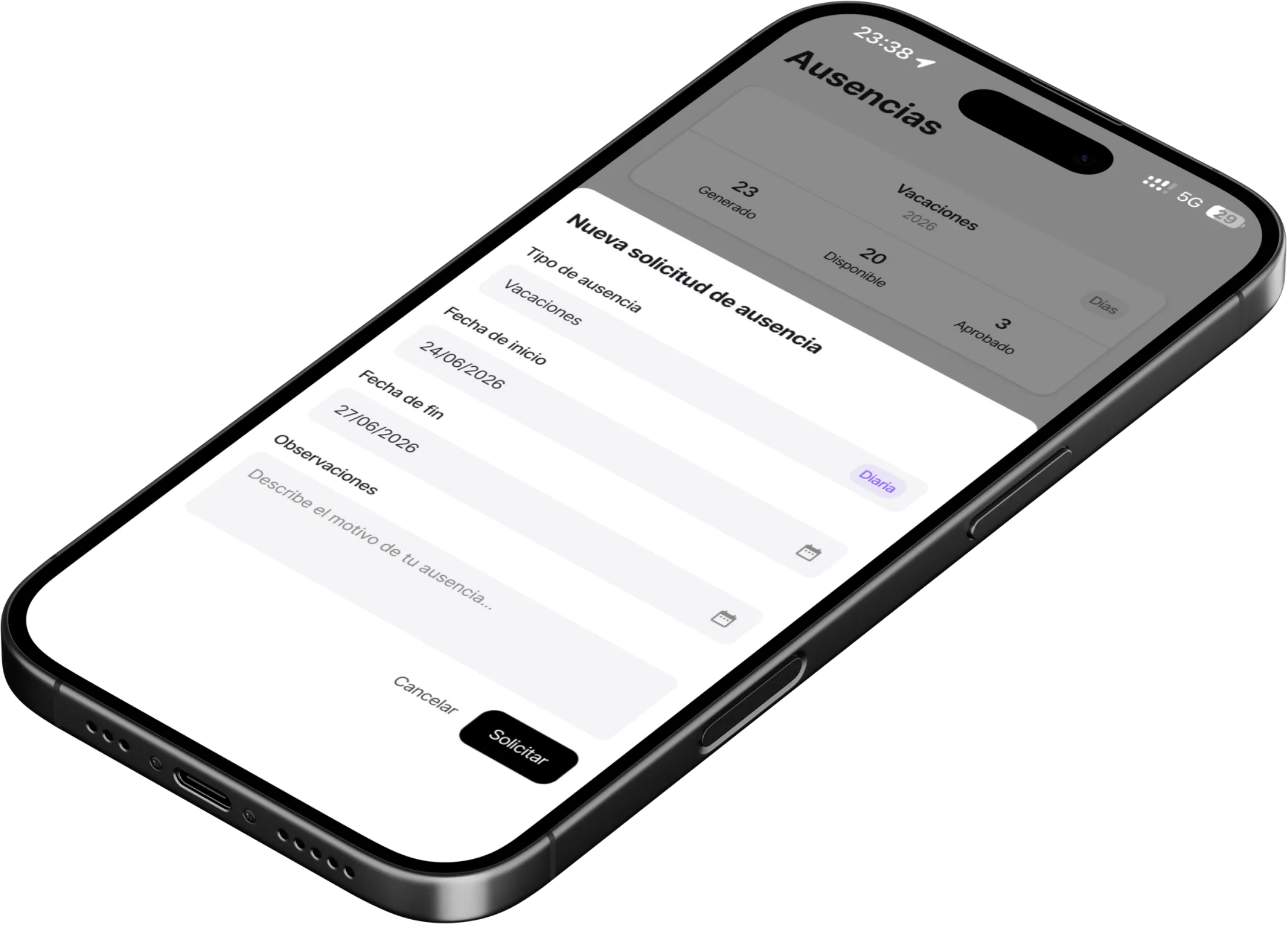
- Request and approve leave from a phone or a browser, with approvers defined for each person.
- Deduct the days automatically, so that everyone can always see how many they have left.
- Attach supporting documents to each absence, as a photo or a file.
- View the team calendar with every approved absence, updated in real time.
- Export absences for payroll or for an inspection.
If you need the details of a specific type of leave, see our guides on the 20 hours of annual training leave and on sick leave and the medical certificate.