Updated:
Mandatory digital time tracking in Spain: where the law stands and when it takes effect
As of 5 October 2026 Spain's digital time tracking decree is still unapproved, but the Ministry considers its review finished and the snap election called for 29 November does not block it. Here is the full timeline of its passage, what the Council of State objected to, why you will only get 20 days from publication to comply, and what Article 34.9 of the Workers' Statute already requires, with fines of up to €7,500 per workplace.
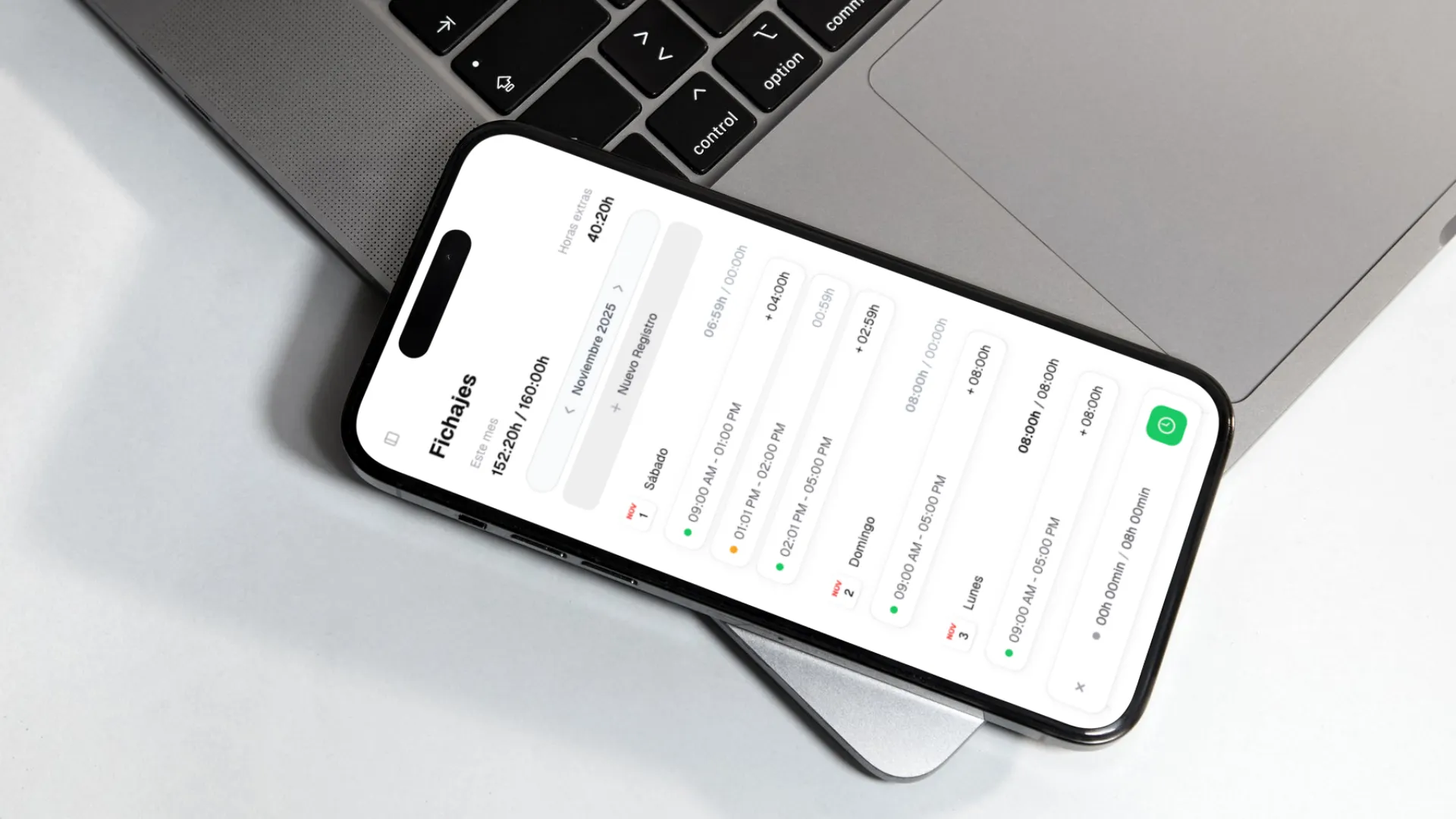
On this page we track the progress of Spain's mandatory digital time tracking regulation and keep it up to date as the process moves. Last updated: 5 October 2026. The royal decree is still unapproved and still has no official date, but two things have happened: the Ministry of Labour now considers finished the review the Council of State demanded, and the government has called a general election for 29 November.
Two things get confused constantly and are worth separating: the new regulation, which does not yet exist, and the duty to record working time, which has been in force since 2019 and which the Labour Inspectorate already fines companies for breaching. Waiting for the decree to be approved before starting to comply means disregarding an obligation that has applied for seven years.
Is mandatory digital time tracking already in force?
No. It is worth saying so plainly, because this is where most of the confusion sits: the regulation that will require time records to be digital does not yet exist. It is still going through the approval process and, as of 5 October 2026, it has neither been published in the BOE nor been given a committed date.
What is in force, and has been since 12 May 2019, is the duty to record working time itself. It was introduced by Royal Decree-Law 8/2019 of 8 March, which gave Article 34.9 of the Workers' Statute its current wording. That provision does not require the record to be digital, but it does require it to be daily, reliable and retained. Today a paper notebook or a spreadsheet is still formally valid, and that is precisely what the new decree will change. If what you need is to compare methods before deciding, we break them down in our guide to what digital clock-in is and how to choose a system.
What the law already requires of you today
The company shall guarantee the daily recording of working time, which must include the specific start and finish time of each worker's working day, without prejudice to the flexible working arrangements set out in this article.
Four obligations follow from that paragraph, and the Labour Inspectorate checks them one by one when it visits a company:
In force since 2019, no decree required
- Daily records: for the entire workforce, including part-time contracts, remote workers and anyone on flexible hours.
- Specific start and finish times: recording only a daily total is not enough, and neither is assuming the hours stated in the contract.
- Four-year retention: records must be available to employees, to their legal representatives and to the Labour Inspectorate.
- An agreed system: the recording system is set by collective agreement or by a company-level agreement. Where there is neither, the employer decides, but must consult the workers' legal representatives first.
If part of your workforce works remotely, Article 14 of Law 10/2021 reinforces that obligation: the record must reflect actual working time outside the workplace too. We explain how to do it in our guide to time tracking for remote work.
Timeline of the decree, step by step
The decree has been a year of announcements and postponements. This is the full sequence, which we update whenever something actually moves:
From September 2025 to today
- September 2025: the government proposes folding digital time tracking into a wider labour reform tied to the reduction of the working week.
- 30 September 2025: the Council of Ministers approves fast-track processing of a standalone decree, now separated from the working-hours reduction.
- October 2025: the public consultation phase opens.
- February 2026: the Ministry of Labour announces approval is a matter of weeks away.
- March 2026: the draft goes to the Council of State for its opinion.
- April 2026: the Council of State issues an unfavourable opinion and returns the text with substantive objections.
- May 2026: despite the opinion, the government maintains it will approve the decree before the summer; Secretary of State Joaquín Pérez Rey announces paper records will be banned that same year.
- 23 July 2026: Yolanda Díaz says the regulation is «practically ready» and will be approved before 31 July.
- 28 July 2026: the Labour and Economy ministries agree to postpone it to September and revise the text over the summer.
- 8 September 2026: the decree does not appear on the Council of Ministers agenda.
- 9 September 2026: after an ultimatum from the UGT union, Díaz says it will be approved «with immediate effect» once the Council of State's legal changes are incorporated, with the deal already closed between Labour, Economy and the PSOE. No date given.
- 29 September 2026: the Council of Ministers approves two housing decrees and other business, but not the working time record.
- 2 October 2026: Pérez Rey declares the review demanded by the Council of State concluded. The Ministry has strengthened the data protection safeguards —following both the data protection authority and the Council itself— and widened the role of collective bargaining in organising the record. It keeps the two defining features: digital, and accessible to the Labour Inspectorate.
- 5 October 2026: Pedro Sánchez announces the dissolution of parliament and calls a general election for 29 November. The regulation remains unapproved and unpublished in the BOE.
Do the 29 November elections block the decree?
It is the immediate question since the dissolution of parliament was announced, and the short answer is no. But it is worth understanding why, because it turns on a technical distinction that is often missed.
The measure will be enacted as a royal decree, not a royal decree-law. Only decree-laws, reserved for cases of «extraordinary and urgent necessity», have to be ratified by Congress within thirty days. A regulation like this one is approved by the Council of Ministers and published in the official gazette without passing through parliament, so the dissolution of the Cortes does not affect it by that route.
It is also worth not getting ahead of the «caretaker government» argument. Article 101.1 of the Constitution is explicit: the government ceases after the elections are held, not when parliament is dissolved. Until 29 November, then, this government retains full powers and can approve the regulation with no legal constraint at all.
What stalled the text: the Council of State's opinion
The Council of State is the advisory body that reviews regulations before they are approved. Its report on this decree was unfavourable, and it is the technical reason the regulation has been stuck for months. These were its objections:
The Council of State's four objections
- Poorly assessed economic impact: the impact statement did not properly quantify the cost to small businesses of replacing their existing systems.
- The wrong legal instrument: some of the obligations imposed would require primary legislation and should not be set by regulation.
- No sectoral adaptation: the text treats sectors with very different working patterns identically, such as hospitality, transport and retail.
- Insufficient data protection: remote access by the Inspectorate and the retention of records were not adequately safeguarded.
A Council of State opinion is not binding, but ignoring it leaves the regulation open to being struck down by the courts. That is why the Ministry of Labour is rewriting those points rather than approving the text as it stands, and why the government now talks about «incorporating the legal changes» before taking it to the Council of Ministers.
When it takes effect: the 20 days that are easily overlooked
This is the part that should concern any company most, and the one explained least. Early versions of the draft allowed a six-month adaptation period, and the Ministry of Economy pushed for a full year for small businesses. The latest known draft removed that provision and falls back on the standard formula: the regulation takes effect twenty days after publication in the BOE.
If the final text keeps that wording, the real calendar looks like this: the Council of Ministers approves it on a Tuesday, it is published in the BOE within days, and your company has under three weeks to get a digital system running, inform the workforce and write the internal protocol. There is no grace period and no transitional regime for small companies.
What the new record will require once approved
The substance of the text has been settled for months and successive drafts agree on the essentials. These are the obligations every company with employees will take on:
Digital time tracking requirements
- Digital format: records must be kept using software or an electronic terminal. Paper and spreadsheets without an audit trail will no longer be valid.
- Complete daily data: specific start and finish times, breaks and interruptions and, where they occur, overtime hours.
- Individual identification: each person clocks in with their own credentials, and nobody can clock in on someone else's behalf.
- Traceability and immutability: no change can be erased; the system must show who made it, when and what changed.
- Immediate employee access: every worker must be able to consult their own records without having to ask anyone.
- Remote access for the Inspectorate: inspectors must be able to consult the data without the employer having to act first.
- Four-year retention, with guaranteed integrity and quick retrieval.
- An internal protocol: the company must document how the system works and inform the whole workforce about its use.
What will be expressly prohibited
Practices the decree rules out
- Recording working time on paper or in spreadsheets without a certified audit trail.
- Rolling out high-risk biometric systems, such as fingerprints or facial recognition, without sufficient technical and legal justification.
- Requiring staff to use their personal phone to clock in without offering an alternative provided by the company.
- Using permanent geolocation, or geolocation beyond what is strictly necessary to evidence that work was performed.
- Altering, deleting or rewriting records without leaving a complete technical trace.
Geolocation deserves precision, because it is the point that causes most confusion: it is lawful if it is limited to recording the location at the moment of clocking in and staff are informed under Article 90 of Spain's data protection act (LOPDGDD). What you cannot do is track an employee throughout the working day. We explain it in detail in our article on time tracking with geolocation.
Penalties: what is at stake in the meantime
Keeping no record of working time, or keeping a defective one, is a serious infringement under Article 7.5 of the consolidated Act on Infringements and Penalties in the Social Order (Royal Legislative Decree 5/2000). The amounts in Article 40.1(b) are as follows:
Serious infringement in employment relations
- Minimum band: €751 to €1,500.
- Medium band: €1,501 to €3,750.
- Maximum band: €3,751 to €7,500.
- The penalty is imposed per workplace, not per affected worker. The number of workers affected serves to set the band (Article 39.2 of the LISOS), not to multiply the amount.
- The fine usually comes alongside regularisation of undeclared overtime, with the corresponding social security contributions and surcharges.
You can estimate your real exposure with our penalty calculator, and see the specific failures the Inspectorate finds most often in our article on how NOT to do time tracking.
What to do now, without waiting for the BOE
The decree will eventually be approved, and the window to adapt will be short. The sensible move is to have the system running beforehand, not least because almost everything it will require is already required by Article 34.9:
Preparation checklist
- Check whether your current record is digital, tamper-evident and accessible to staff. If it is still paper or a spreadsheet, the risk already exists today.
- Verify that you hold records for the last 4 years and can retrieve them during an inspection.
- Make sure breaks and overtime are recorded, not just clock-in and clock-out.
- Write the internal protocol for using the system and inform the entire workforce.
- Negotiate or consult on the system with the workers' legal representatives, as Article 34.9 requires.
- Work out the real cost before deciding: we break it down in our article on the cost of the new time tracking rules.
How to comply today with Horalia
Horalia covers working time records as Article 34.9 requires them today and as the new decree will require them, so you will not have to switch tools when it is published:
What Horalia handles
- Clocking in from wherever each person works: mobile app, web panel and a clock-in terminal — a tablet at a fixed point where each person identifies themselves with a personal code.
- Geolocation at clock-in: records the location at the moment of clocking in, for staff who travel between sites.
- Traceable corrections: if someone forgets to clock in, the correction is approved by their manager and logged, never silently overwritten.
- Working time reports exportable in the official format, with hours worked per employee, overtime, absences and shifts: exactly what the Inspectorate asks for, ready to hand over.
- An hours balance per employee: the hours over and under contract, so you can settle them as time off or in payroll.
And because working time records never travel alone, the same tool gives you absences and holidays, working schedules, shifts and rotas, document management with electronic signature and a whistleblowing channel. You can see it working with your own data in the free trial.