Best working time tracking software for the self-employed and SMEs 2026
We analyse the best working time tracking software for the self-employed and SMEs in 2026: what each one offers, which best meets the new legal requirements and which fits your team size.
With the new mandatory digital working time record on the verge of approval, choosing the right software in 2026 is no longer optional — it is a legal requirement. The right tool automates tracking, eliminates manual errors and keeps employment records in order without taking up hours of your day. And if an inspection comes, it protects you.
We analyse the most relevant solutions for the self-employed and SMEs in 2026: what each one offers, which wins on each criterion and which fits best depending on your team size and working model.
What any working time software must have in 2026
Before comparing options, it is worth being clear about the non-negotiable minimum requirement: the software must include a modification log with a timestamp. Without it, records carry no evidentiary value before the Labour Inspectorate, regardless of the price or extra features.
Key technical requirements for 2026
Any valid solution must meet at least these criteria:
- Digital recording of start, end and break times with precision to the second.
- Modification log with full traceability and evidentiary value.
- Worker authentication mechanisms (without mandatory biometrics).
- GDPR compliance and servers located within the European Economic Area.
- Remote access to records for the Labour Inspectorate.
- Exportable reports for labour audits.
Horalia: the most complete option for Spanish self-employed and SMEs
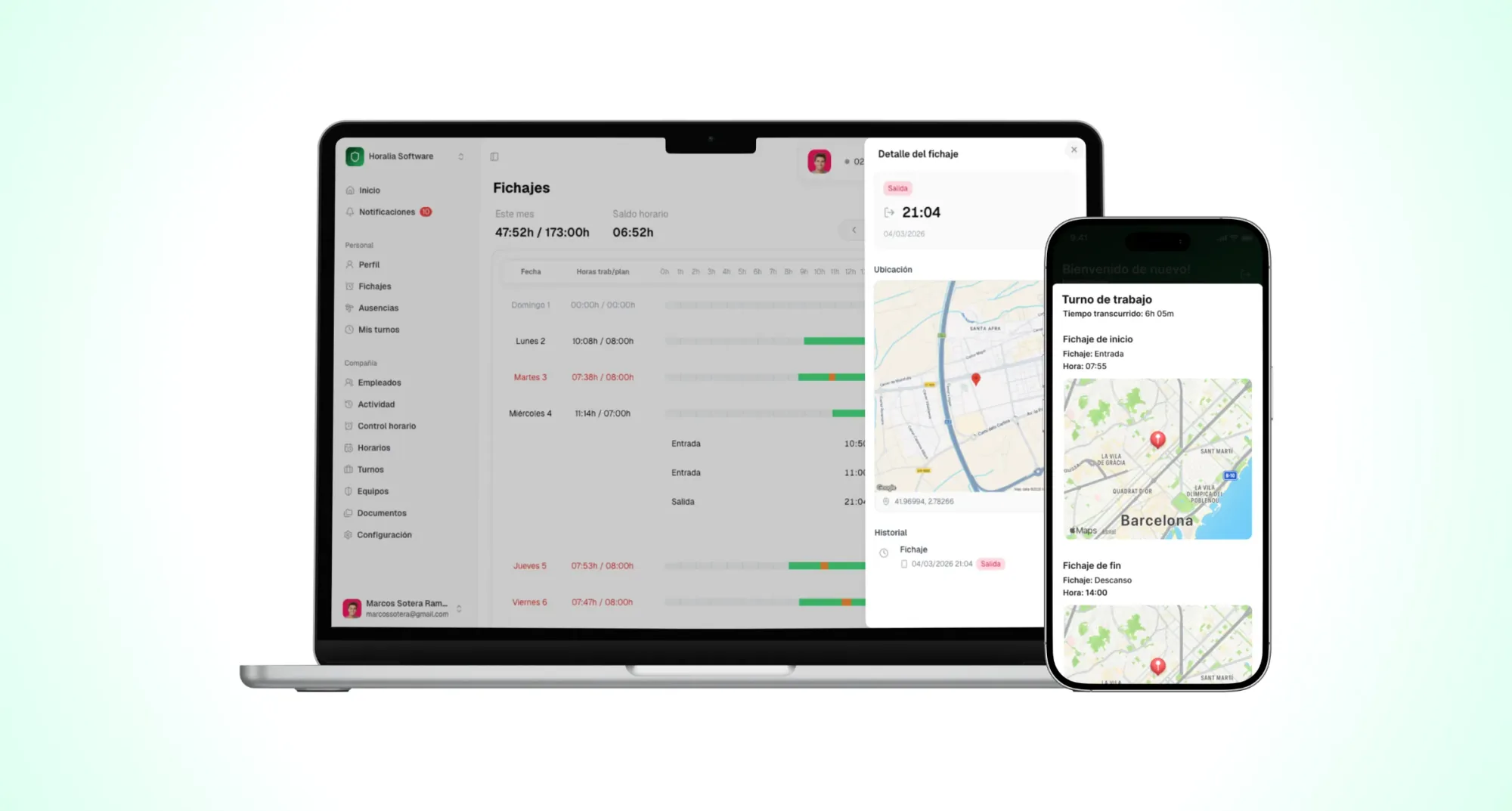
Horalia is the working time control platform designed specifically for the Spanish market, with full compliance with Royal Decree-Law 8/2019 and built to meet the new technical requirements of the 2026 mandatory digital working time record. Unlike generic solutions, Horalia was built from the ground up with a focus on legal compliance and ease of use for the end worker.
Horalia's main features
Everything a self-employed professional or SME needs to comply with the regulation:
- Multi-device clock-in: mobile (iOS and Android), tablet and web desktop.
- Automatic recording to the second: clock-ins, clock-outs and breaks.
- Shift, schedule and absence management from a single platform.
- Automatic legal reports valid for labour inspections.
- Document management with integrated advanced electronic signature.
- No long-term commitment and setup in under 5 minutes.
- Technical support included in all plans.
Horalia also stands out for its simple, intuitive and modern interface: any employee can clock in from day one without any prior training. The design is built for the end worker, not the IT administrator, which reduces friction and speeds up adoption across the team.
One of the features most valued by its users is immediate deployment: account creation, employee setup and first clock-in all on the same day. For self-employed professionals and SMEs that cannot afford weeks of training or complex integrations, that makes a real difference.
Horalia is fully compliant with Royal Decree-Law 8/2019 and is ready for the new requirements of the 2026 mandatory digital working time record.
TramitApp: clock-in combined with document management
TramitApp is a labour management tool that combines attendance recording with document administration. It is particularly useful for self-employed professionals who need to centralise the employment relationship beyond simple clock-ins: contracts, communications, absence reports and digital signature all from one platform.
TramitApp's strengths
- Daily attendance recording.
- Labour document management and digital signature.
- Employee communications and absence reports.
- Automated alerts and notifications.
- Holiday and leave management.
Its main limitation is that pricing is not publicly listed: it requires direct consultation with the provider, which complicates comparison for SMEs looking to make quick decisions. Its interface also prioritises document management over agile clock-in, which can mean a steeper learning curve.
Factorial HR: full suite for medium and larger teams
Factorial HR is a comprehensive HR suite that includes, among other modules, working time recording. It is a solid option for companies that already need — or will soon need — payroll, recruitment and performance evaluation on the same platform.
Factorial HR's strengths
- Working time control integrated into the HR suite.
- Recruitment, payroll and performance evaluation modules.
- Shift and absence management.
- Mobile clock-in app.
- PDF and Excel report export.
The main drawback for the self-employed and micro-businesses is its pricing model: a flat rate of €115.90/month for up to 19 employees, regardless of whether the team has 3 or 19 people. For small or variable teams, that fixed cost is hard to justify when only working time tracking is needed.
Comparison: which is best by team size
Team size is the single biggest factor in choosing the right solution. Not all features make sense at every scale, and paying for what you do not use is the most common mistake when selecting working time software.
Recommendation by number of employees
- 1 employee → Horalia. Covers all legal requirements from day one, without unnecessary features or disproportionate cost.
- Up to 5 workers → Horalia. Visual shift management, automatic overtime calculation and team notifications included.
- 5–10 workers → Horalia or TramitApp. Horalia remains the strongest option for pure working time recording; TramitApp becomes more relevant if document management is frequently needed.
- 10–200 workers → Horalia. Multi-team shift management, simultaneous absence tracking and group reports with full traceability.
- 200+ employees → Consider Factorial if a full HR suite with integrated payroll and recruitment is needed; Horalia remains a strong option if the priority is legal working time control without added complexity.
Which is best by working model
The working model also determines which features are essential. Managing an on-site team at a single location is very different from coordinating remote workers or staff across multiple sites.
Recommendation by working model
- On-site: Horalia enables clock-in from any device at the workplace. With no manual input needed, hour calculations are automatic and error-free.
- Remote or hybrid: Horalia operates without biometric data, with a consistent experience across web and app, in line with data protection authority guidelines.
- Mobile or field workers: Horalia's mobile app allows recording working hours from anywhere, available on both iOS and Android.
- Variable or seasonal workforce: no commitment and no minimum fees — Horalia does not penalise periods of lower activity.
How to choose the right working time software
Three questions cover 90% of the decision. Answering them before evaluating options prevents contracting more than you need — or falling short when an inspection arrives.
The three key questions
- Does your headcount fluctuate or is it stable? → If it fluctuates, prioritise solutions with no base fee and no minimum commitment.
- Do you need just working time tracking, or also payroll and document management? → Specialist app vs. full HR suite.
- What working model does your team follow? → Remote and mobile workers need biometric-free mobile clock-in; variable teams need flexible onboarding and offboarding.